

| Carhué » | Epecuen Lake History » | Tourism in Carhué » |
 |
|
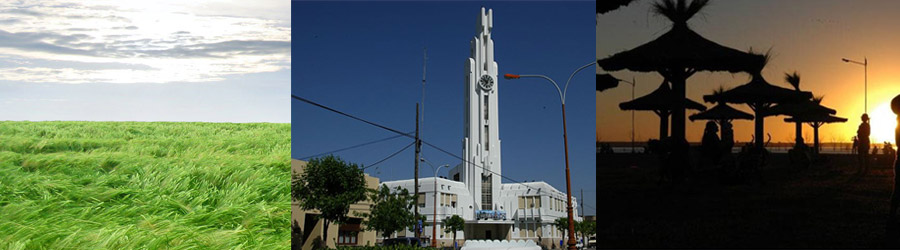
CARHUE Carhué is a city of the Province of Buenos Aires, Argentina, head of the county of Adolfo Alsina. It has about 10,000 inhabitants and is located on the shores of Lake Epecuén (famous for its healing properties) and near the stream Pigüé, It’s name derives from the Mapuche language, meaning "green place" and comes from the Mapudungun words carre (green) and hue (place). The Epecuén lake is a body of water located at the lowest point of the drainage basin, “Encadenadas del oeste ” system, in the province of Buenos Aires, Argentina. It is the sixth and last of the lakes of this system, as well as the largest in area. Recives overflow from Lake “La Paraguaya” through a canal and several creeks as Pigüé and Pull Grande, coming down from the Sierra de la Ventana. His condition of last collecting point in the system makes the water level change constantly. Located at the bottom of a depression, the water level thereof decreases only by evaporation. For its high salt concentration, the lake is hypersaline, with a salt content ten times that of the sea. Its waters are used to fight depression, rheumatism, several skin condition and psychophysical exhaustion. Carhué City is located on the edge of the lake. Lago Epecuén was first mentioned in 1770 by a pilot of the Spanish Royal Navy, Pablo Zizur, with the name of San Lucas. St. Luke is the patron of medicine. |
 |
 |